
Choosing a Merchandise Partner: What to Actually Compare
Key takeaways
- "Do you own your factory?" is the wrong question to open with. Ask who answers when a date moves instead.
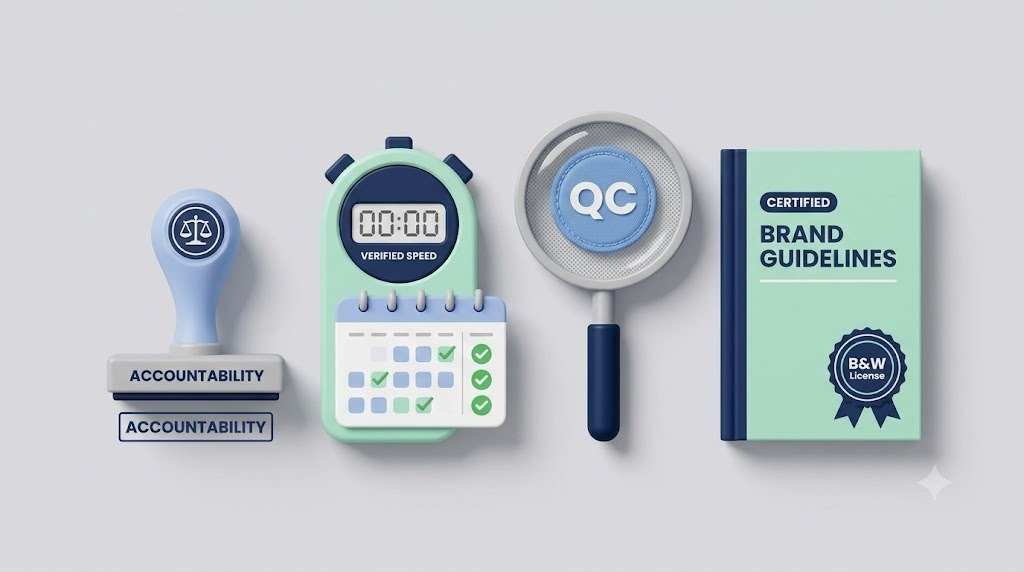
- Four things actually decide a program: accountability, proven speed, quality that holds, and licensing fluency.
- A real partner can show you dates they delivered early, with numbers attached, not just a promise.
- Licensed merchandise runs on the brand manual as law. A partner who doesn't know that rhythm learns it on your deadline.
The question everyone asks first, do you own your factory, decides less than a missed deadline does.
Every merchandise program starts with the same meeting. You sit with a potential partner, and at some point that question arrives. It sounds like the most important thing in the room. It is rarely the one that decides.
Two models are common in this trade. One company makes everything on its own production floor. Another assigns each order to the specialist best suited for it, through a vetted partner-factory network. Both can deliver excellent work. Both can miss a deadline. Ownership of a building tells you little about which outcome your program gets, so compare the things that decide instead.
Wrong question: "Do you own your factory?"
Right question: "Who speaks to me when a date moves?"
One name answers for the whole program, or you become your own PM
Your order passes through many hands no matter who runs it: design, materials, production, QC, packing. What changes is who stands in front of you. If you find yourself coordinating suppliers yourself, you have quietly become your own production manager. A partner who runs the whole program answers for the whole program, and that feels different, especially when a date slips.
Japanese licensors insist on this. Takara's OEM programs for Doraemon, Shin-chan, and One Piece, 26 SKUs across apparel and merchandise, ran on a single point of accountability, because Japanese licensing works that way: the licensee answers for the factory, the quality, and the date. There is no middle step that says someone else handled it. See how this shows up across real programs on the portfolio page.
Ask every candidate the same question: when a sample fails or a date moves, who speaks to me, and can they change the outcome? The right answer is one name.
Speed with proof, and quality that holds
Every partner promises on-time delivery. Few can show you the last program they delivered early, with dates attached. So ask for dates.
Real numbers: Rohto, 2025: R1 samples for the first 3 designs in 7 days, 23,400 units produced, delivered 25 days ahead of contract.
In 2025, Rohto Vietnam needed 7 character designs approved before a fixed campaign window. Takara had R1 samples for the first 3 designs ready in 7 days, produced 23,400 units, and the whole order landed 25 days ahead of contract. In 2024, the BIDU mascot for World Trade Center went from concept sketch to a 5-size costume in 14 days, and Keppel Land's 1,500-set gift program shipped on time in 30.
Every program passes 3-stage QC before anything ships, because early delivery with defects is just an expensive debt paid later. See the full 3-stage QC process for how that holds under a tight calendar.
Fast versus rushed: know the difference. Fast comes from a schedule with room to move and honest updates. Rushed comes from a date no one believes.
Licensing fluency is a survival skill
Licensed merchandise is not a normal order. The brand manual is the law: colors, proportions, packaging, even the small print on a tag. A partner who has never worked directly with a licensor will be learning those rules against your deadline.
Takara became a Pokémon licensee in 2016 and grew that program across 230+ retail doors, from Ministop and Aeon Mall to Phuong Nam Books, with e-commerce sales up 35% in the first three months. Thirteen years in, per the same discipline described on the About page, every brand manual is still treated as the contract it is.
Licensing also changes the pace of a program. A licensed product cannot ship the day a character appears on screen; it must be approved first, and approval is a process with its own rhythm. A partner who knows that rhythm keeps your program out of the red tape.
When you interview a partner, ask who on the team reads the brand manual, and what happened the last time a licensor rejected a sample. The answer tells you exactly how the next rejection will go.
The 4-point checklist before you sign
What a partner owns matters less than what they deliver. Ask for evidence of all four, then judge candidates on work they have already shipped:
- Accountability: one name who answers for the whole program, not a chain of suppliers you coordinate yourself.
- Proven speed: real dates from a real program, not a promise.
- Quality that holds: a documented QC process, not a claim.
- Licensing fluency: someone on the team who has actually read a brand manual before.
None of this makes the factory question meaningless. It is worth asking, just less decisive than the people running the program, the dates they can prove, and the licenses they have kept clean.
Frequently asked questions
Should I work with a trading company or a factory?
Both models can deliver excellent work and both can miss a deadline, so ownership of a building tells you little. Compare four things instead: one accountable owner for the whole program, proven speed with real dates, a documented quality process, and experience working with licensors.
What should I ask a potential merchandise partner first?
Who speaks to you when a sample fails or a date moves, and whether that person can change the outcome. The right answer is one name. If you end up coordinating suppliers yourself, you have become your own production manager.
How can I check a partner's speed claims?
Ask for dates from a program they have already delivered. For example, for Rohto Vietnam in 2025 Takara had R1 samples for the first 3 designs in 7 days, produced 23,400 units and delivered 25 days ahead of contract.
Why does licensing experience matter?
In licensed merchandise the brand manual works like a contract, covering colors, proportions, packaging and tag text, and every product needs licensor approval, which has its own rhythm. Ask who on the team reads the brand manual and what happened the last time a licensor rejected a sample.
Does Takara own a factory?
No. Takara assigns each order to a vetted partner factory suited to the product and runs the whole program, from sampling and quality control to delivery, as the single point of accountability for the client.